

By Walter J. McDonald
High-performance Service and Parts Operations ultimately drive success in all areas of the machinery dealer business. Excellence in Service and Parts is just the ticket to play in today’s highly competitive market. If your Service and Parts performance is deficient, so is your Customer Service. And, this low-performing image casts a dark shadow over your entire Machinery Sales and Rental campaign.
So, how is your Service and Parts Operations performing now? An accurate, objective, inexpensive way is to determine how your Parts and Service quantitative scores compare to those of high-performance machinery dealers. This assessment will indicate which specific areas are in most need of improvement.
The next step is to determine what changes or course corrections in your policies and procedures would have the greatest positive impact on performance.
Use the following five-step procedure to identify your operations performance deficiencies, structure remedial actions and successfully implement changes. You only need these two textbooks as reference materials available on our website: www.mcdonaldgroupinc.com

1. Benchmark Your Operations
Build a Spreadsheet for the key metrics shown below. There are 50 metrics in my Achieving Excellence in Machinery Dealer/Distributor Performance, text. However, the 18 Performance Benchmarks shown below are all you need for this triage assessment. Each is described in detail in Achieving Excellence, pages 66 – 130. These 18 data points would be entirely sufficient and provide a comprehensive baseline evaluation.
In Company Overall, look at:
1*) Sales Mix Overall (Parts & Service should be over 35% total dealer sales), p. 66.
2) Absorption Rate, p. 68.
4) Gross Profit Margin by Department, p. 70.
6) Profit After Direct Expense, p. 73.
8) Days in Receivables, p. 74.
In Parts Department, look at:
11) Off Shelf Fill Rate to Service for Focus Products (Primary Line), p. 79.
12) Parts Inventory Turns, p. 81.
13) Parts Obsolescence, p. 82.
1n Service Department, look at:
17) Service Sales Mix, p. 90.
22) Effective Service Gross Margin – P&L, p. 93.
26) Technician Productivity (Individual & Overall), p. 97
30) Days Work in Process, p. 99.
31) Service Rework, p. 102.
32) Right Part 1st Trip, p. 102.
*Benchmark Number in the text.
In Customer Service and Retention, also look at:
Customer email % Accurate, Usable: Goal – Over 85%.
Product Support Email promotional mailings: Goal – 2 per Month.
On-going Customer Satisfaction Surveys: Goal – 8 per Week for Repair Orders.
Product Support Status Calls from Customers: Goal – Receive under 5 per week.
2. Analyze Scores
Which of your scores appear to be deficient when compared to high- performance dealer benchmarks? What appears to be the root cause(s) of each low-performing area? How would improvements in each area benefit your dealership? Please contact me if you would like any assistance performing this assessment. walt@mcdonaldgroupinc.com.
3. Project the Financial Value of Improvement
Begin with Benchmark Number 1, “Sales Mix Overall.” What would be the financial value of increasing your parts and service sales to 35% of overall dealer sales? For Benchmark Number 26), “Technician Productivity,” what would be the incremental billing value of all technicians achieving 90% productivity? These are usually the two highest potential areas to look first. Next is Parts Obsolescence. This can be a huge cash trap.
The four bonus Customer Retention questions are based on very recent research on what most impacts Customer Retention and Repeat Business.
4. Identify High-Impact Policies and Procedures that Drive Operations Performance Improvement
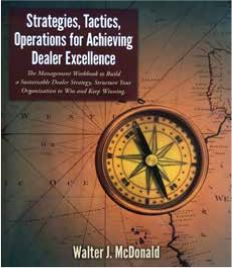
In Strategies, Tactics, Operations for Achieving Dealer Excellence, world-class Best Practices are presented in the form of Operations Audits. Review each Audit. Identify policies and procedures that would fit the needs of your organization.
Parts Operations Audit: 96 questions, pages 191 – 236.
Service Operations Audit : 177 questions, pages 237 – 270.
Customer Service and Retention Audit: 28 questions, pages 191 – 219
Also, of value in the Strategies, Tactics, Operations text are comprehensive audits for Used Machinery Sales and Operations, Rental Sales and Operations, New Equipment Sales and Marketing Management and, Strategy Management for Dealer Owners and Executives.
5. Structure and Implement Remedial Action Plans
There are only 4 very essential steps to getting Action Plans implemented.
- Appoint a Bus Driver (Manager) for each major Action Item who is accountable for successful implementation.
- Identify and choose no more than 2 or 3 Action Items for each Department.
- Structure quantitative performance metrics that will be monitored to indicate implementation progress and ultimate success
- Organize regular progress reviews.
# # # #
You are welcome to contact me to discuss any aspect of this Operations Improvement initiative: walt@mcdonaldgroupinc.com.