
By Walter J. McDonald
(Editor’s Note: The is the second in our two-part series on Acquiring and Developing Key Accounts. CAUTION: Do not attempt this process unless you are motivated and willing to work through each step. You should complete the entire set of readings before you begin to pull together and implement your Action Plan.)
Very large and important customer relationships go far beyond financial value and embody mutual benefit, friendship, loyalty and trust. Both entities thrive by sharing strengths, focused objectives, trust and a natural living bond that goes beyond financial transactions. The handshake illustrates a firm warm alliance and an enduring partnership on an epic scale. In this article we explore insights, tools and techniques essential to build and foster those powerful partnerships.
In this Action Plan you will
- Evaluate Vulnerabilities of your current Key Account practices.
- Review who should be on the Key Account Team.
- Examine a Universal Account Coverage Plan.
- Identify Ideal Achievable Competitive Advantages.
- Build the Account Profile, Highlighting Influencer Preferences and FEARS.
- Establish and Pursue Business Potentials for All Dealer Products and Services.
- Learn How to Avoid the Biggest Vulnerabilities and Dodge the Mistakes in Key Account Management and Development.
Required Tools
If you are ready to start, you need two powerful tools to participate in this adventure. These essential Sales Management resource materials contain our comprehensive guide to maintaining and developing current Key Accounts as well as strategic steps essential to winning large new customers. Your cash investment is only $155.00.
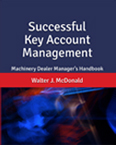
Successful Key Account Manager Machinery Dealer Manager’s Handbook.
By Walter J. McDonald (Paperback, 232 pages.).
Available HERE on our website on sale for only $75.00.
(Symbol “KAM” below.)
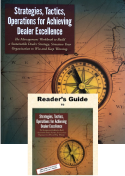
Strategies, Tactics, Operations for Achieving Dealer Excellence.
By Walter J. McDonald (Paperback, 612 pages + Reader’s Guide).
Available HERE on our website on sale for only $80.00.
(Symbol “STO” below.)
Essential Steps
Here are crucial steps that other high-performance machinery and equipment dealers have found to be most helpful:
- In KAM, study the fundamental principles of Key Account Management, starting in the “Foreword, page xii, through page 6.
Highlight the most important concepts for your dealership.
Assess your current strengths in managing a large, very important account once you have established them as a customer. What areas do you need to improve before continuing on this expedition? - In KAM, review “Assemble the Key Account Team,” pages 7 – 11.
Who will play what role? Do you understand why this TEAM approach is essential? - In KAM, study “Contact Strategy to Successfully Service All Accounts to Optimize Market Share,” pages 113 – 123.
Developing and maintaining Key Accounts must be accomplished within the context of shared responsibilities for building relationships with all customers. This is an excellent solution to that complex challenge. - In KAM, study the section “Analyze Customer Ranking Reports…,“ pages 65 – 84. Develop a Key Account Customer Ranking Report by Aftermarket Sales Opportunity by beginning with your 50 largest customers over the past three years by including total machinery, parts and service sales for each account. This is an excellent way to prioritize your Key Account Development efforts. Begin with the 10 accounts with the largest Aftermarket Sales Potential as determined on page 83. In addition to improving account relationships, you will be generating high margin revenues.
- In KAM, study “How Customers Evaluate a Potential Machinery Dealer,” pages 43 – 52.
What are customers looking for and what do they expect from a vendor that provides them hundreds of thousands of dollars in complex machinery? Is your dealership ready to meet these expectations? - In KAM, read “Establish Product Support as a Competitive Weapon,” pages 53 – 64.
From this reading it should be clear that Key Account Management is a dealer TEAM EFFORT. No one person can do it alone in a machinery dealership. Why do you think Product Support has emerged as such a qualifying factor in successful Key Account Management and Development. - In KAM, study “Gather Relevant, Important Facts about the Key Account,” pages 13 – 21.
Build the profiles of your target accounts. This is your basic working tool. The more you understand their business, the more effective will be your Key Account development efforts. What additional information would you add to the profiles? - In KAM, “Identify and Define Roles of Each Major Purchase Decision Maker,” pages 23 – 29. And, “Clarify Influencer Preferences and Fears,” pages 31 – 34.
Not only must you identify and define the role of each influencer, but you must also make certain you understand their individual preferences and especially, the fears. Why be concerned about their FEARS? (Hint: No matter how bad their current supplier is, they may fear you could be worse!) - In KAM study and reflect on “Determine How the Account Views Our Dealership (and YOU) on the Relationship Hierarchy,” pages 35 – 42.
The challenge is to improve the customer’s perception. Are you just selling a commodity with only price and availability as your sales pitch. Or, are you providing expert solutions that yield real benefits to the customer. - In KAM, examine “How to Sell Large, Complex Engineered Systems (and Machinery),” pages 135 – 140.
Make sure you understand how to use the diagnostic interview guide on page 136. - In STO read “Putting it All Together for your Dealership” on pages 356 – 367.
Why do you think it is important to start with Aftermarket Product Support? - In KAM, study the section “How to Dodge the Biggest Mistakes in Key Account Management,” pages 183 – 185.
- In KAM, study the section “How to Avoid the Biggest Vulnerabilities in Key Account Management,” pages 197 – 189.
- In STO, review “Product Support Capabilities Brochure,” pages 142 – 145. This informative sales tool could be the most useful way that you can reinforce your dealership’s capabilities and resources.
Please contact me for a copy of the first article in this series, “How to Capture New, Never-before Large Key Accounts. I’d also welcome your questions: